Lift and coast
리프트 앤 코스트
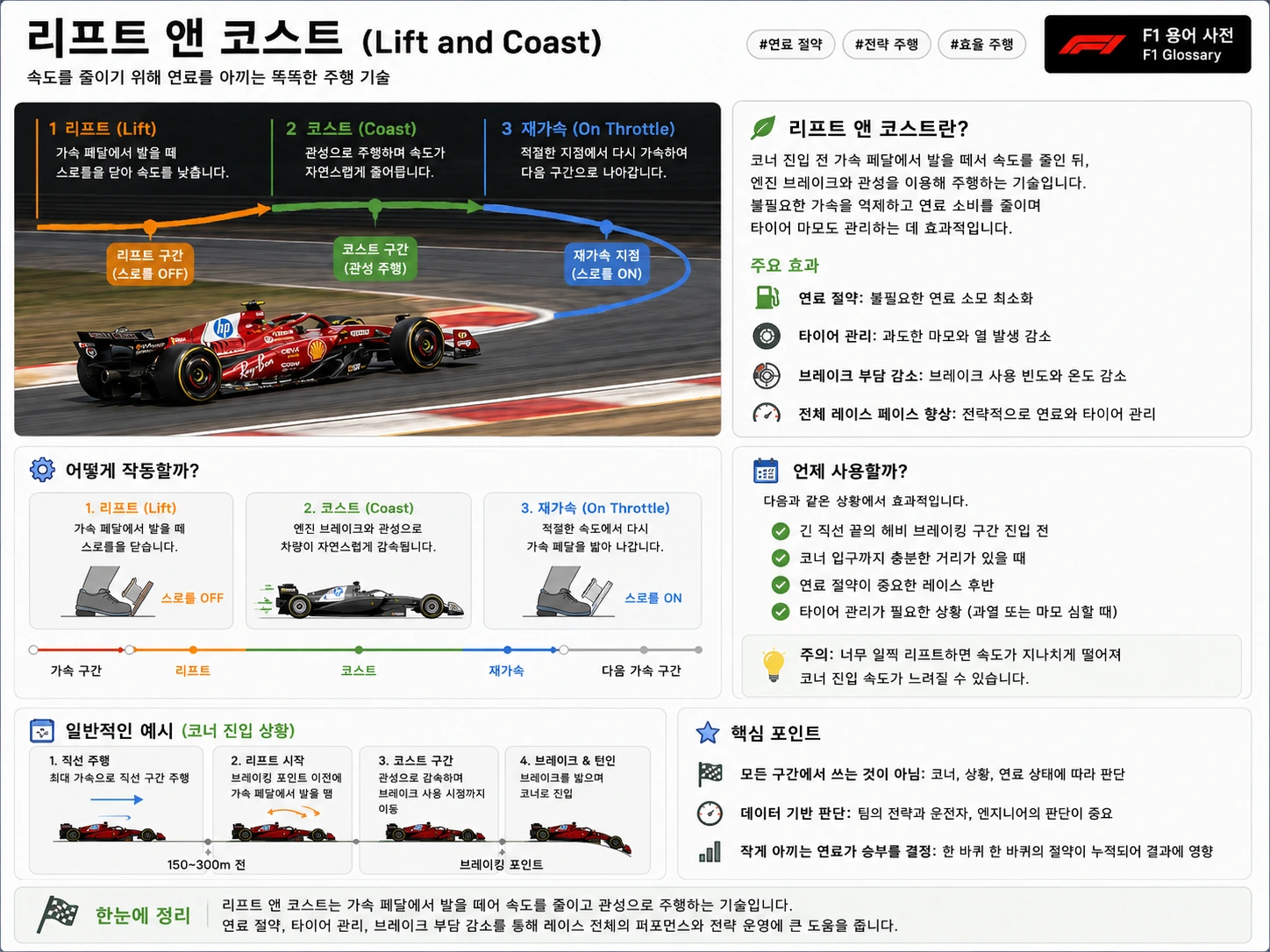
This technique involves lifting off the throttle earlier than usual before entering a corner, allowing the car to coast on inertia before applying the brakes. It is frequently used during a race to conserve fuel or to cool down the engine and brakes while minimizing lap time loss.
🏆 Structured Case
General ScenarioWhy lift before the braking zone?
On a maximum-attack lap, a driver normally stays on the throttle until the braking point and then brakes hard. With lift and coast, the driver comes off the throttle earlier, allows the car to coast and only then begins braking. This can cost some lap time but reduces fuel consumption and brake load. With the 2026 power units, lift-off can also be used for controlled electrical energy recovery, giving the technique an additional energy-management dimension.
The defining feature of lift and coast is releasing the throttle before the normal braking point and allowing the car to coast.
📺 Race Context & Viewing Tips
Frequently asked questions
Why do F1 drivers use lift and coast?
Does lift and coast always make a car much slower?
🔎 Looking for another F1 term?