Slipstream
슬립스트림
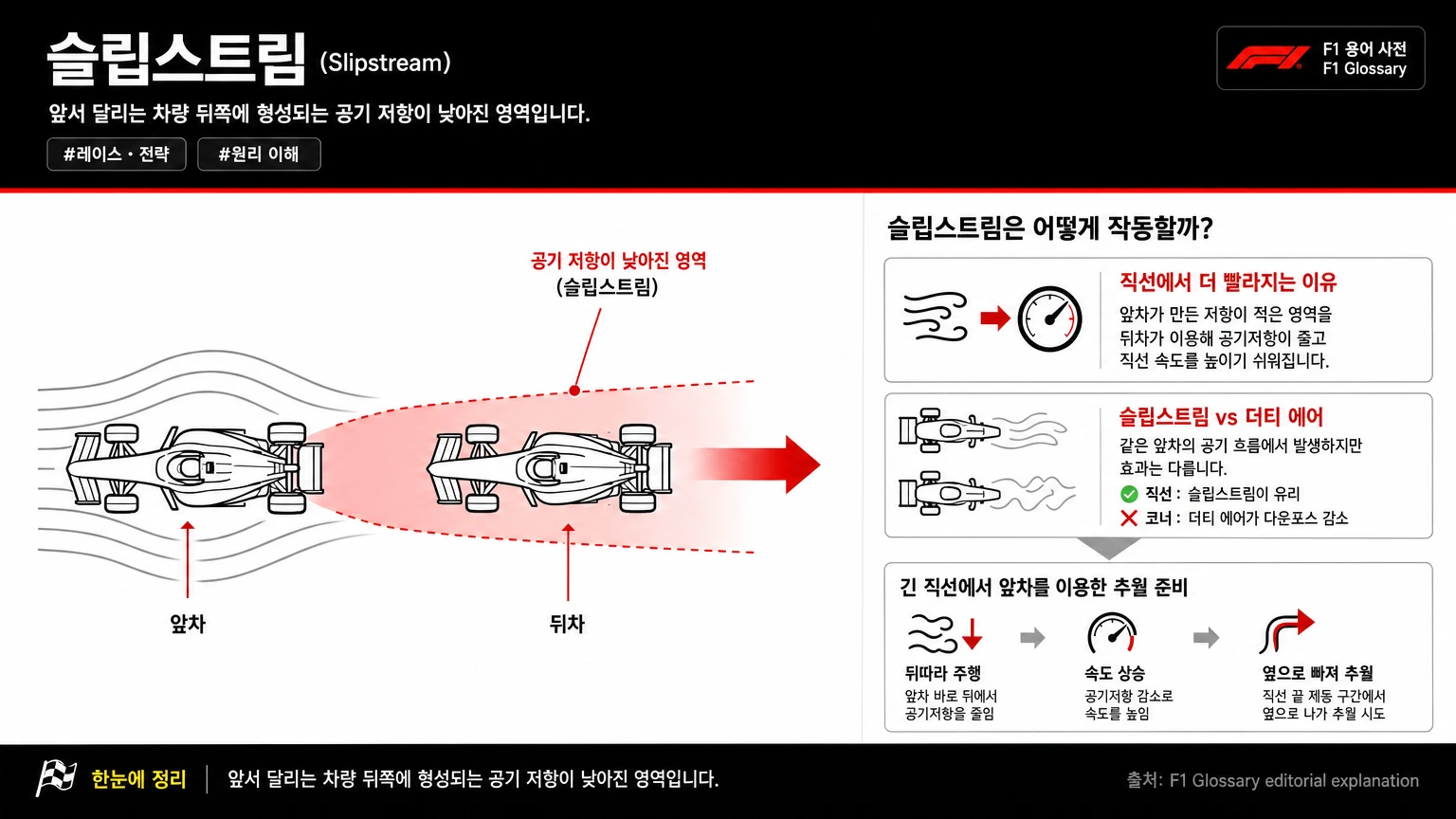
It is the area of reduced aerodynamic drag formed behind a leading car. When a trailing car enters this zone, it experiences less air resistance, making acceleration easier and overtaking more advantageous.
🏆 Structured Case
Race EventHow the fight for a tow cost drivers their final Monza Q3 lap
At Monza, the long straights make a good tow especially valuable. During Q3 at the 2019 Italian Grand Prix, drivers slowed dramatically on their out-laps while trying to position themselves behind another car for the best slipstream. Eight of the ten Q3 drivers failed to cross the line in time to begin a final timed lap, showing how positioning for a tow can become almost as important as outright qualifying pace.
Drivers wanted to use the slipstream behind another car to reduce drag and gain lap time on the straights.
📺 Race Context & Viewing Tips
Frequently asked questions
Why does a slipstream help a car go faster on a straight?
Are slipstream and dirty air the same phenomenon?
🔎 Looking for another F1 term?