Qualifying
퀄리파잉
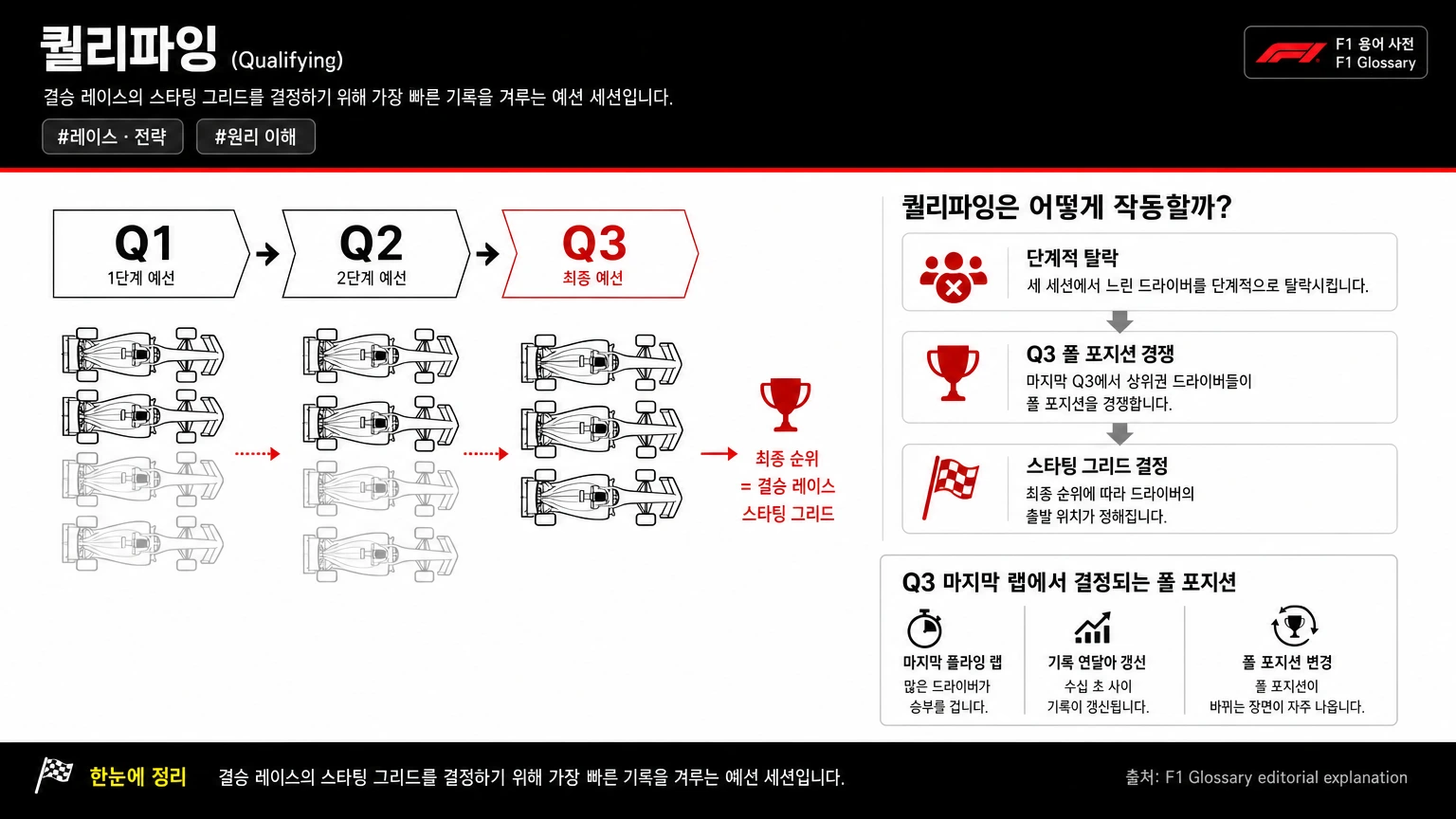
A qualifying session in which drivers compete for the fastest lap times to determine the starting grid for the race. It is conducted in three stages: Q1, Q2, and Q3, with the final positions determining the drivers' starting positions.
🏆 Structured Case
General ScenarioWhy does the track get faster late in qualifying?
In qualifying, lap times often improve late in the session even when the same car and tyre compound are used. As more cars circulate, rubber is laid onto the racing line and the available grip of the track surface increases. This track evolution encourages teams to begin their final flying laps as late as practical, when the circuit is at its fastest. Waiting too long, however, also creates the risk of losing the lap to a yellow flag or the end of the session.
Qualifying makes track evolution especially important because teams compete to time their final laps for the best circuit conditions.
🏆 Structured Case
Race EventHow the fight for a tow cost drivers their final Monza Q3 lap
At Monza, the long straights make a good tow especially valuable. During Q3 at the 2019 Italian Grand Prix, drivers slowed dramatically on their out-laps while trying to position themselves behind another car for the best slipstream. Eight of the ten Q3 drivers failed to cross the line in time to begin a final timed lap, showing how positioning for a tow can become almost as important as outright qualifying pace.
Because Q3 has a strict time limit, delaying the out-lap to find a tow ultimately cost most drivers their final flying lap.
📺 Race Context & Viewing Tips
Frequently asked questions
Why is F1 qualifying divided into Q1, Q2 and Q3?
What advantage does pole position provide?
🔎 Looking for another F1 term?