Pit stop
피트 스톱
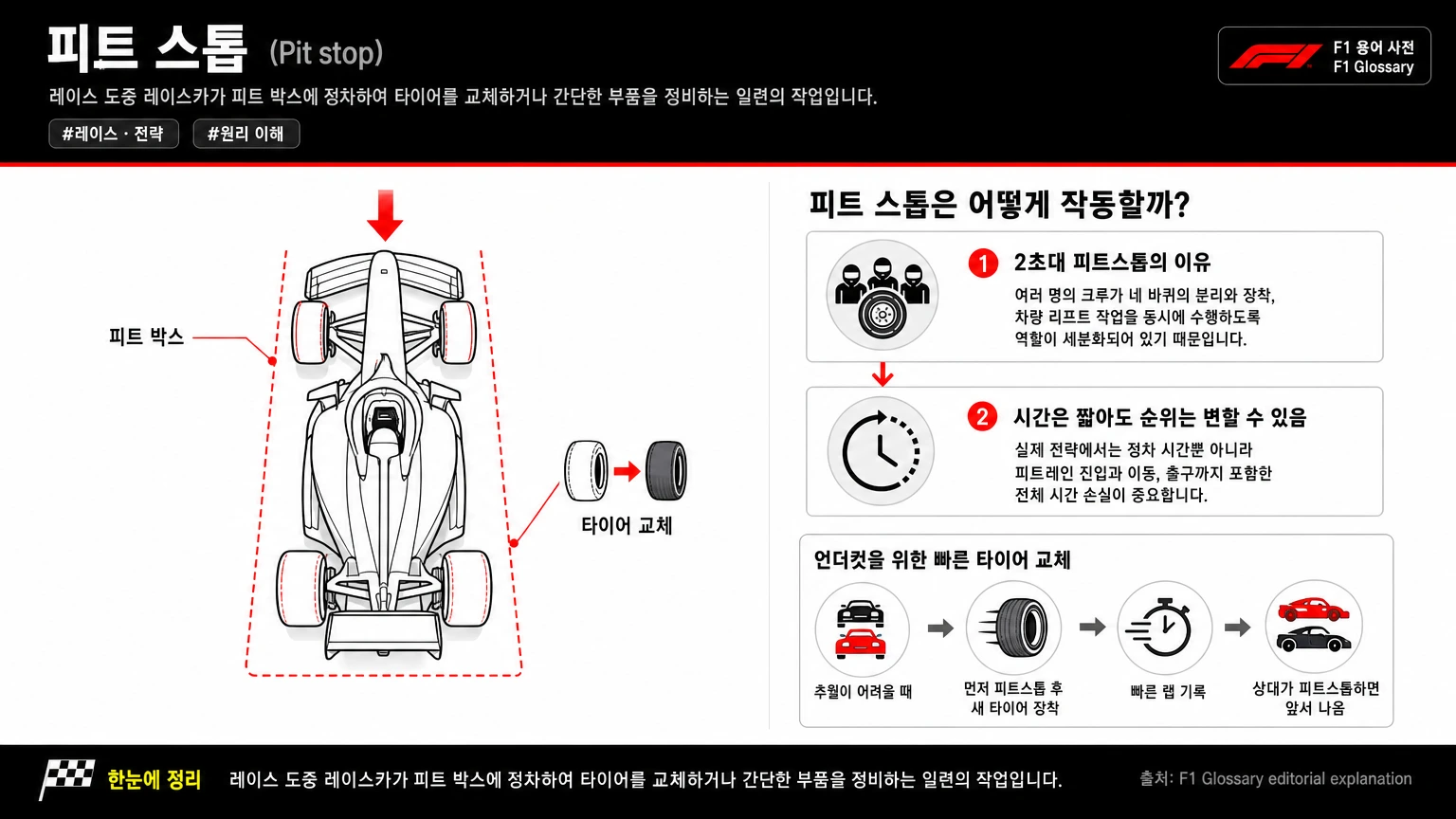
During a race, the race car stops in the pit box to change tires or perform minor maintenance on components. In dry conditions, races require the use of at least two different tire compounds, so this procedure is typically carried out at least once in most events.
🏆 Structured Case
Race EventThe undercut that put Verstappen ahead in France
At the 2021 French Grand Prix, Max Verstappen pitted on Lap 18 before race leader Lewis Hamilton. Verstappen used the extra grip from his fresh tyres to produce a strong out-lap, and when Hamilton stopped one lap later the Red Bull moved ahead. The key to an undercut is not simply stopping first, but gaining enough lap time on fresh tyres to overturn the existing gap.
An undercut depends on pit-stop timing, stationary time and the immediate performance of the fresh tyres.
🏆 Structured Case
Race EventA Safety Car changed the value of a pit stop
Late in the 2022 British Grand Prix, a Safety Car was deployed after Esteban Ocon stopped on track. Carlos Sainz used the opportunity to pit for fresh soft tyres while race leader Charles Leclerc stayed out. Sainz passed Leclerc after the restart and went on to win, while Leclerc eventually fell to fourth. A Safety Car does more than slow the race down: it can reduce the relative time lost by making a pit stop and completely change the strategic calculation.
During a neutralised race, the relative time loss of a pit stop can be reduced, increasing the value of changing tyres.
🏆 Structured Case
Race EventThe late rain call that decided Sochi
Late in the 2021 Russian Grand Prix, staying on slick tyres initially appeared to be the faster option as rain began to fall. As conditions worsened, Lewis Hamilton switched to intermediates while race leader Lando Norris remained on slicks. Norris eventually slid off as grip disappeared and Hamilton took the lead. The key decision was not simply whether it was raining, but when the grip advantage of intermediates became greater than the time lost in the pit stop.
Changing tyres required accepting the time loss of a pit stop, making the timing of the stop the crucial strategic decision.
🏆 Structured Case
Race EventMercedes double-stacked both cars as the rain arrived
When rain arrived on Lap 28 of the 2024 British Grand Prix, Mercedes called Lewis Hamilton and George Russell into the pits on the same lap and switched both cars to intermediate tyres. The crew completed the double stack without a major delay between the two cars. A double stack can change the strategy of both team cars at once, but any delay on the first car can force the second car to wait in the pit lane.
The spacing and execution of the two pit stops were essential to making both strategy changes work.
📺 Race Context & Viewing Tips
Frequently asked questions
How are F1 pit stops possible in around two seconds?
Can a driver lose a position even with a very fast pit stop?
🔎 Looking for another F1 term?